Connect this guide with the rest of your visit in the Phuket trip planner. Read how the research is made and what its sources establish.
At a glance
Start here
- Tin prosperity helps explain the scale and confidence of Old Town's building stock.
- Mixed communities shaped streets, food, worship and education as well as ornament.
- Terraced shophouses and detached mansions reveal different relationships between commerce, family and land.
- Modern reuse is part of the district's story, but visible heritage does not make every interior public.
01
Tin created an urban economy, not just mines
TAT links Phuket Old Town's growth to the prosperity of tin mining, while the provincial Old Town page associates its early twentieth-century formation with Chinese residents who made fortunes in that economy. Mining matters here because extraction generated trade, labour movement, administration and spending that appeared in streets, schools, houses and businesses.
A useful visitor question is therefore not where the mine was, but where mining wealth circulated. Look for substantial terraces, large houses, institutional buildings and routes that connect commercial streets. Avoid reducing the story to one ethnic group or one architectural label; TAT identifies Chinese, Indian, European and Muslim settlers among the people who traded or established roots.
- Look for evidence of commerce as well as decoration.
- Connect buildings to institutions and street position.
- Do not assign wealth or occupation to a house without evidence.
02
Migration shaped more than facades
The official Phuket destination page notes strong Chinese influence alongside multiple ethnic traditions. The day-route page broadens that picture by naming Chinese, Indian, European and Muslim settlers. Their presence should not be read as a tidy blend in which every group contributed one decorative motif; communities formed businesses, religious places, schools, foods and family networks.
Read the street as a collection of institutions. A shrine, school building, food shop and commercial terrace may tell more about community continuity than a famous photo corner. When a sign supplies a name or date, record it. When it does not, describe only what is visible and take the open question to a museum rather than filling it with folklore.
- Notice religious and educational buildings.
- Separate a community's documented presence from stylistic guesswork.
- Use official labels for personal and institutional names.
03
The shophouse is a working building type
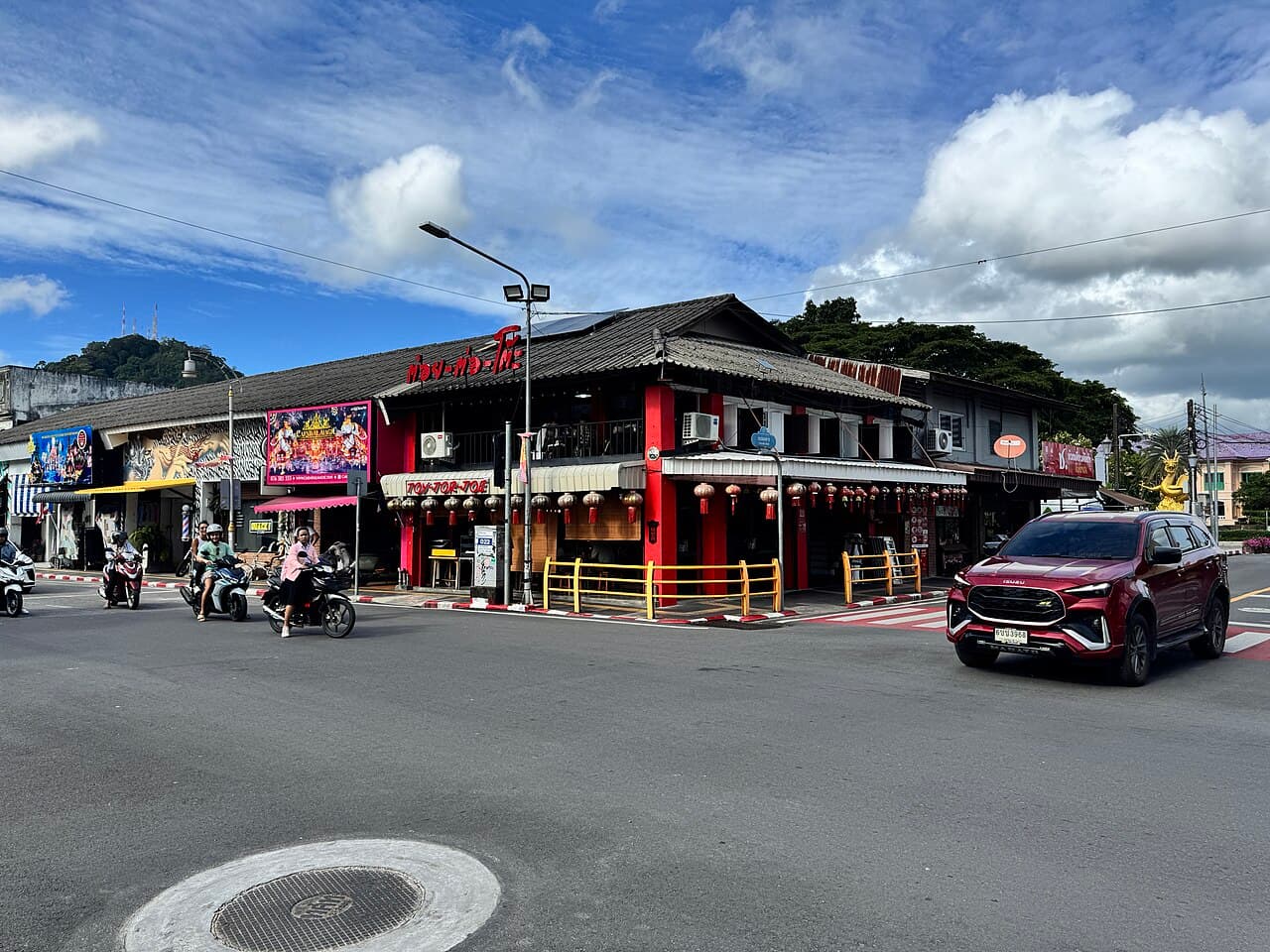
TAT describes terraced homes in a Sino-European tradition along Old Town's roads. Their repeated narrow frontages create a continuous street wall, but the depth behind the facade allowed domestic, commercial and service functions to coexist. This helps explain why the ground floor and upper floor can read differently from the street.
Instead of cataloguing colours, compare bays, shutters, doors, ventilation openings, covered edges and signs of internal courtyards. These are observation prompts, not a claim that every house follows one plan. Alterations, rebuilding and new uses complicate the pattern. A building should be dated or classified precisely only when an official interpretation source does so.
- Compare repeated widths across one block.
- Look at how shade and ventilation are handled.
- Notice where commercial signs respect or interrupt the facade rhythm.
04
Mansions change the scale of the story
TAT's official route pairs Old Town and Thai Hua with Chinpracha House, signalling that detached houses belong in the same historical reading as terraces. A mansion uses a larger plot, more visible setback and a different boundary between street and residence. That contrast speaks to status and land, even before an interior is considered.
Do not assume a photogenic property is a museum. Check its current official or owner channel, respect gates and keep private thresholds clear. The meaningful comparison can be made from lawful public space: continuous commercial frontage on one street, then a larger compound on another. The change in scale is evidence; an invented family story is not.
- Compare plot width and setback.
- Use current property information before planning entry.
- Treat gates as boundaries, not invitations.
05
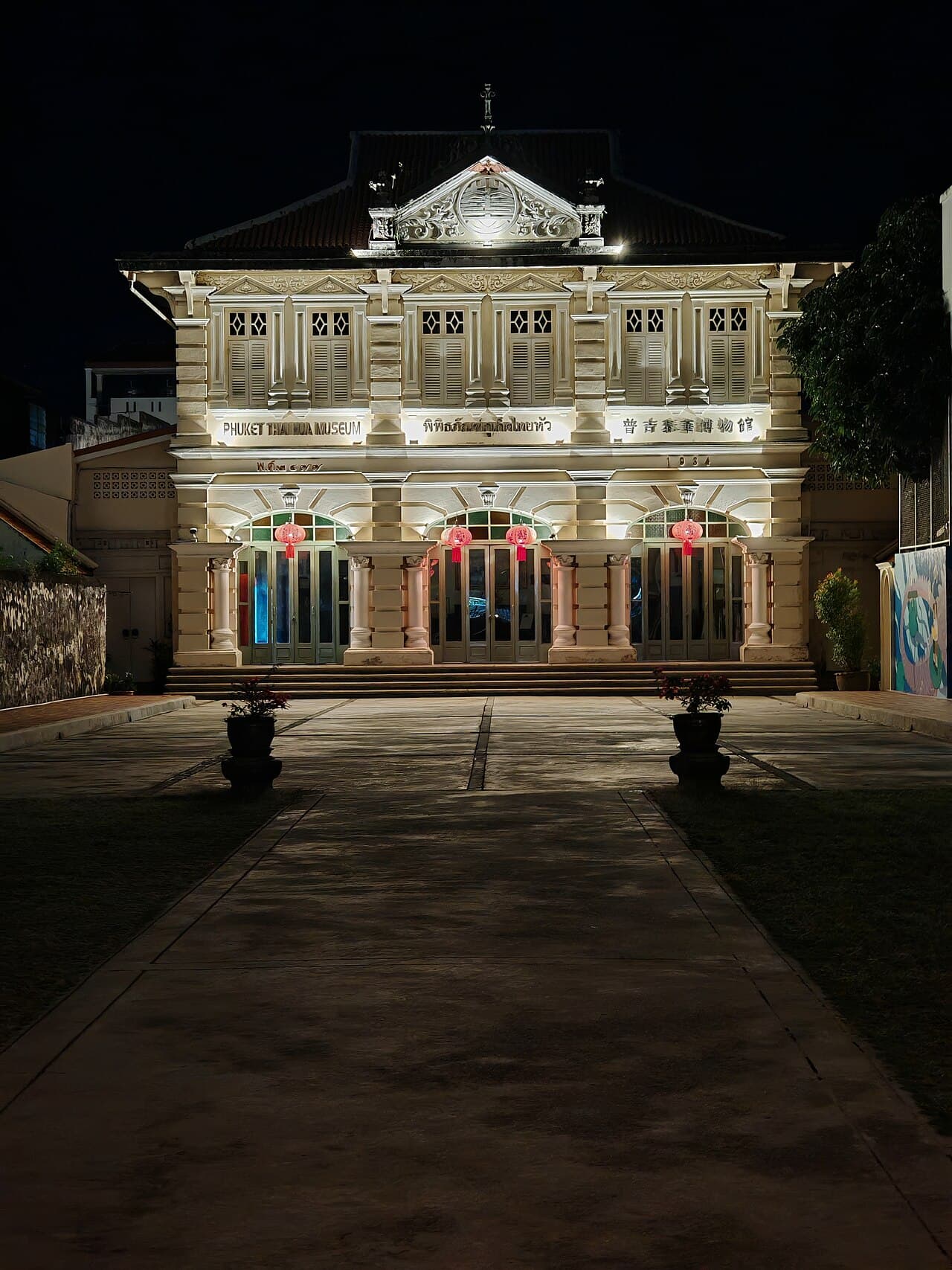
Thai Hua connects school, community and city
The provincial museum page identifies Thai Hua as a former Chinese school built by Hokkien residents and describes displays about historical figures, clothing, food, festivals and the move from mining to tourism. The building therefore represents both architecture and an institution created to transmit knowledge and values within a community.
That institutional history changes how the facade should be read. It was not simply a mansion or shop. Use the museum to ask who founded schools, what children learned and how community memory is curated now. Verify current entry details directly; the old provincial page's opening claim is not sufficient for a future visit.
- Look for the red bat motif described by the provincial page.
- Connect exhibition themes back to nearby streets.
- Treat the museum's current labels as stronger evidence than social captions.
06
Reuse keeps the town active and complicates it
TAT notes that many historic buildings now function as accommodation, dining spaces, coffee shops and souvenir businesses. Adaptive reuse can keep a building occupied and visible, but it can also change interiors, signage and street activity. The town visitors see is therefore a continuing commercial district, not a complete preservation of one year.
Read reuse critically but fairly. Ask what old fabric remains visible, what the new function adds, and whether the public presentation explains the building's history. Spend money only where the service is genuinely wanted, avoid blocking daily business, and remember that an attractive exterior does not grant access. Old Town's meaning lies in continued use as much as in visual consistency.
- Distinguish preservation from themed decoration.
- Notice how new signs meet old proportions.
- Support a business through normal custom, not intrusive photography.
Useful answers
Reader questions
Is Sino-Portuguese the only accurate label for Old Town architecture?
Official English pages use both Sino-Portuguese and Sino-European. Use the term supplied for a specific building or route, and avoid assuming one label explains every structure.
Sources: Phuket Provincial Governor's Office; Tourism Authority of ThailandWhy was tin so important to Phuket Town?
Official sources connect tin prosperity to migration, trade and the wealth behind Old Town's development. The urban legacy includes housing, commerce and institutions, not only mining sites.
Sources: Tourism Authority of Thailand; Phuket Provincial Governor's OfficeWhat makes Thai Hua Museum relevant to the architecture story?
It was a Chinese school as well as a distinctive building, so it connects architecture with education, Hokkien community history and the town's shift from mining to tourism.
Sources: Phuket Provincial Governor's OfficeCan facade colours identify a building's exact age?
No. Colour and decoration alone do not prove a construction date. Use a museum label, plaque, archive or property source for exact attribution.
Sources: Tourism Authority of ThailandRead the evidence
Sources and further reading
These sources support the relevant sections above. Plans and comparisons are editorial suggestions. Check operators for current arrangements.
- Phuket ↗Tourism Authority of Thailand · Research date 14 September 2026
Phuket's Chinese influence, multiple communities and broader island context.
- Recommended Route for One Day ↗Tourism Authority of Thailand · Research date 14 September 2026
Named Old Town streets, multicultural settlement, terraced Sino-European buildings, tin prosperity and reuse.
- STROLL THE HISTORIC ROADS IN PHUKET OLD TOWN ↗Tourism Authority of Thailand · Research date 14 September 2026
Old Town's compact street form, mining background, mixed architectural influences and Thai Hua's heritage role.
- Old Town Phuket ↗Phuket Provincial Governor's Office · Research date 14 September 2026
The district's early twentieth-century development, tin-mining wealth, Chinese residents and Sino-Portuguese streetscape.
- Phuket Thai Hua Museum ↗Phuket Provincial Governor's Office · Research date 14 September 2026
Thai Hua's former-school role, Hokkien connection, architectural motif and exhibition subjects.